For some years now, mainstream media have published, continue to publish, and will keep publishing articles about the immense energy expenditure required to keep the Bitcoin network running. Some outlets claim it accounts for 1% of total global energy consumption. The conclusion they want to draw — or rather, the opinion they want to create in the reader — is obvious: if it consumes that much, Bitcoin is bad for the environment.
In this way, they seek to turn against Bitcoin all those who care about the environment and want sustainable energy development based on renewable sources. I happen to be one of those people — committed to sustainable energy development — so the topic concerns me quite a bit.
Is it true? Is it really that harmful?
First, let’s calculate how much energy is actually consumed today and compare it to the global total, to see how realistic the 1% estimate is. Then we’ll consider whether it makes sense to seek a more efficient algorithm or hardware to reduce this consumption. Finally, we’ll look at the synergy that Bitcoin mining has with renewable energy sources.
Part I: Calculating Bitcoin’s Energy Consumption
Before doing some calculations, let’s briefly look at what mining consists of, for our purposes. Bitcoin solves a fundamental problem in achieving peer-to-peer electronic cash. It is the double-spending problem — how to prevent a specific amount of currency from being used twice, in two transactions. This is trivial with physical money (you can’t give the same banknote to two people, since once you give it to one you no longer have it) or with electronic money through a trusted third party (a bank), but it was an unsolved problem in a peer-to-peer setting, without a trusted third party for electronic money. Satoshi solved it by having all nodes reach consensus on the history of transactions, and that consensus protocol is based on Proof of Work.
What is Proof of Work? In essence it consists of making it artificially difficult for a block to be valid. How? For a block of transactions to be valid, it’s not enough for all the transactions within it to be valid. There is an additional requirement: the hash of the block header (SHA-256) must be smaller than a certain value (the target). This makes it very hard to produce a valid block. The rate at which blocks appear on the network is 1 block every 10 minutes on average, regardless of how many people are mining. If few people mine it becomes easier; if more people mine it becomes harder. Bitcoin self-adjusts the difficulty every 2,016 blocks so that the average remains one block every 10 minutes.
And… why would anyone dedicate their CPU resources and energy to finding blocks? For the reward of finding a valid block, which consists of the newly issued bitcoin in that block (newly created bitcoin) plus the transaction fees included in the block. This incentive structure ensures that miners (those performing the hashes to find valid blocks) spontaneously dedicate resources (hardware + energy) to this task. Performing SHA-256 operations consumes energy. So the mining business essentially consists of consuming energy and selling the mined bitcoin to pay for it. Hence the name, since the analogy with traditional mining — of gold, for example — is complete in this sense.
How do we know how much energy Bitcoin consumes? We must note that mining takes place all over the world, and anyone who wishes can mine, without restrictions. There is no registry of who is mining, no “mining licence” (in Bitcoin everything is voluntary and permissionless), so we cannot simply look up that figure in a register. It must be calculated. How do we calculate it? With some data and by making approximations and assumptions. Let’s go through them: The total hashing capacity of the Bitcoin network in August 2020 was 130 Exahashes/s (130,000,000,000,000,000,000 hashes/s). (II)
Taking data from one of the most efficient miners, the Bitmain AntMiner S17 Pro (I):
- Hashing power: 53 Th/s
- Power consumption: 2,094 W
- Efficiency: 40 J/Th, or equivalently, 11 kWh/EH
With this data, how much energy does the network consume in a year?
Et = H × Eh = 130 × 3600 × 24 × 365 × 11 = 45 × 10⁹ kWh
That is, 45 TWh.
Possible objections:
1. Not all mining equipment is the AntMiner S17 Pro.
True, not all of it is. But for the business to be profitable, you cannot mine with equipment that is significantly less efficient. Mining takes place where energy is cheapest and with the most efficient equipment. In fact, with the current hash rate and Bitcoin price, even with the most efficient miner, an energy price below $0.05/kWh is required to be profitable — which is quite cheap. If energy costs more than what you earn from the mined bitcoin, the more you mine, the more you lose.
But what if you have access to very cheap energy? Even then, it doesn’t make much sense to mine with inefficient equipment. If at a given moment a miner with half the efficiency of the S17 yields a 5% margin (for example), then a margin of over 50% would be obtained with the more efficient equipment. That is, if efficiency doubles, the margin doesn’t go from 5% to 10% — it goes from 5% to 50%. In other words, there are very strong incentives to mine with the most efficient equipment at any given time, and as ASIC technology improves to increase efficiency, older (less efficient) machines progressively go out of use. For all these reasons, it’s reasonable to base the estimate on an efficient miner — one that is already a year old. Nevertheless, for a conservative calculation, let’s add 30% more energy. This gives us 58 TWh instead of 45.
2. Energy for cooling must also be considered.
True. Not all the energy consumed in a data centre goes to the electronic equipment. There is other equipment that also consumes power, largely for cooling. The PUE coefficient (Power Usage Effectiveness) is a measure of data centre efficiency. It is the total energy consumed by the DC divided by the energy consumed by the servers (in our case the miners). Data centres with a PUE below 1.2 are considered efficient. The average PUE of Google’s data centres is 1.11. According to the University of Cambridge study (IV), the PUE of data centres dedicated to Bitcoin mining is around 1.1. Is this figure reasonable? In practice it’s not possible to carry out an exhaustive analysis of all mining farms, and even then we wouldn’t arrive at an exact value, since anyone can mine from home by joining a pool. Not all mining capacity is in data centres. But we can note two things:
- Who can mine? Anyone. Bitcoin is permissionless.
- Where can mining take place? Anywhere in the world.
Since there are practically no barriers to entry, the business is always very tight. This means there will be no large server farms where, in addition to paying for the electricity consumed by the miners, a significant amount must also be paid to cool them. Such farms would not be profitable. On the other hand, there are cases where the heat produced is not wasted but used to heat a home or a building. In this case, not only is no cooling needed, but the heat produced by mining, far from being waste, is actually useful. A miner in this scenario is also an electric heater. The cost of cooling could even be considered negative. The Cambridge University data therefore seems quite reasonable. Even so, in this analysis we’ll be conservative and use 1.2 rather than 1.1. Applying this factor to the previously obtained value gives us 70 TWh.
Now for the other side: how much energy is consumed worldwide in a year?
This is a figure we cannot calculate ourselves, but there are various estimates that don’t differ greatly from one another. We use the Wikipedia figure: 157,000 TWh per year. (III) With this, Bitcoin’s share of total consumption is: 70 / 157,000 = 0.045%.
In summary, after the above analysis and correction factors, we can say that:
In 2020, the Bitcoin network consumes less than 0.05% of total global energy.
Is that a lot? “A lot” is relative and subjective. In the next section we’ll analyse whether it is or not, but for now we have established something very important that should not be overlooked: every article claiming Bitcoin consumes 1% of global energy is, at best, garbage. I say “at best” because some are something far worse: deliberate propaganda. Propaganda with the goal of creating a very negative opinion among those of us who care about the environment and sustainable development.
Let’s now turn to the second aspect: the claim that even if it’s not 1%, too much energy is “wasted” because the protocol is inefficient.
Part II: Bitcoin’s Energy Consumption Is Excessive and Inefficient
This part is less straightforward. It’s not just a matter of taking some numbers, multiplying and dividing, and finding that we’ve been misled. As I said, “a lot” or “excessive” is relative and subjective.
But the error is fundamental, because in trying to judge whether the consumption is excessive or not, we are assuming that the more it consumes the worse it is. That, in my opinion, is a mistake that stems from not understanding where Bitcoin’s immutability and security come from. Essentially, what is being presented as a problem is actually a fundamental feature. Let’s see why this energy expenditure is not harmful — and certainly not inefficient.
Some blockchain enthusiasts assume that immutability is an inherent property of a blockchain simply because the blocks are linked by hash pointers, but this is not the case. Without Proof of Work, a desktop PC could rewrite the entire blockchain (the entire transaction history) in no time, since only a “few” hashes would be needed to rewrite everything.
Without Proof of Work, to change something in block 1 one would have to recalculate the hash of block 1 and therefore modify the pointer in block 2, which would change the hash of block 2 and require recalculating it to write into block 3, and so on. One hash per block… fewer than a million hashes. PC graphics cards can perform millions of hashes per second, so without a mechanism additional to the blockchain structure itself (without Proof of Work), the entire history could easily be rewritten.
Immutability is not a property of blockchain; it is a property of Proof of Work + blockchain.
With Proof of Work, the difficulty of rewriting the latest block is proportional to the difficulty of finding that valid block. The difficulty of rewriting a previous block is at least double, since two valid blocks must be computed (here the blockchain structure does play a role, as the blocks are chained by hash pointers)… and all of this must be done in less time than it takes the rest of the network to find the next one.
The harder it is to find a block (the more hashes are required), the more energy is needed — therefore, the more energy, the greater the security (immutability). Do we want Bitcoin to be less secure? Do we want actors to be able to rewrite the transaction history in order to perhaps censor certain transactions or steal our money? No. We do not want Bitcoin to be less secure. Therefore:
We do not want Bitcoin to consume less energy. It is precisely the energy it consumes that provides the security.
But what if we found a more “efficient” algorithm? We’d want that, right? Well, counterintuitive as it may seem, the reality is that it wouldn’t help at all. Here’s why:
Suppose we found a hash function with all the properties of SHA-256 (used in Bitcoin) but for which hardware could be built that is ten times more energy-efficient per hash — that is, one hash with this new algorithm could be computed using ten times less energy. Well, if that happened, the network would soon be performing ten times more hashes, and the total energy cost would be the same.
Why? Couldn’t it consume ten times less and still function the same? No. Bitcoin is open — and this is not just a nice word. In fact it is open in many senses: obviously as an open-source project, but also in that it is open to anyone who wants to participate in the network; anyone can run a node.
What does this have to do with algorithm efficiency and energy consumption? Everything. Suppose a new algorithm is discovered that consumes ten times less. Suppose that with the “old” algorithm miners spend $60,000 in electricity per block and the revenue from selling the bitcoin in the generated block is $61,000 — they earn $1,000 per block. If the algorithm were suddenly changed and generating a block cost $6,000 (ten times less)… then per block they would earn $55,000… What would that miner do? What would the rest of us do? Put more resources into mining. For a brief period miners would earn more and blocks would appear more frequently than every 10 minutes, but very soon the difficulty would adjust (increasing). Blocks would return to appearing every 10 minutes, but with ten times as many hashes. In reality, the efficiency of the algorithm doesn’t matter:
The cost of producing a block will always tend to equalise with the revenue from producing it.
No matter how efficient a new algorithm is, it makes no difference — energy consumption will always be determined by the number of bitcoin obtained per block multiplied by the price of bitcoin. Just two variables, entirely unrelated to the efficiency of mining equipment or algorithms. Some might think that if the price keeps rising, energy consumption will increase indefinitely. But that need not be the case either, since Satoshi hard-coded Bitcoin’s emission curve into the protocol. In block h (h for height), the number of newly created bitcoin (called the “subsidy”) is:
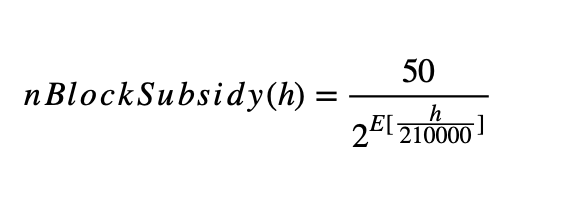 where E[x] denotes the integer part of x.
This means 50 new bitcoin in each block during the first 210,000 blocks, 25 bitcoin per block in the next 210,000, 12.5 in the following ones, and so on, halving every 210,000 blocks (approximately every 4 years). That is, fewer and fewer bitcoin are issued over time. In fact, a point will eventually be reached where no more are issued. We have known — since the very beginning — what the total amount of bitcoin created will be, given by:
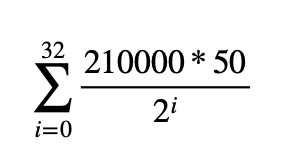
Which is slightly less than (due to rounding to eight decimal places) 21 million.
Since fewer and fewer are issued, there are also those who worry that a point will come when no new bitcoin are issued (approximately the year 2140) and therefore there will be no miners. Will the network stop?
No, that won’t happen either. In fact, long before that year, miners’ revenue from fees will exceed their revenue from newly issued bitcoin per block. Today miners’ rewards are dominated by newly created (issued) bitcoin, but since this reward halves every 210,000 blocks, a point will come where miners’ rewards will consist primarily of the transaction fees included in the block.
Finally, I want to highlight that it is contradictory to simultaneously worry about whether consumption is too high and whether miners have insufficient revenue. As we saw earlier, miners’ rewards and energy expenditure are two ways of looking at the same quantity. We cannot be concerned about how large one is and how small the other is, because they are the same thing.
Summary:
-
- The energy Bitcoin consumes is not 1%. It is currently less than 0.05%.
-
- This expenditure, large or small, does not depend on technology — neither on the efficiency of ASICs nor on the algorithms used. It makes no sense to look for a “low-consumption” algorithm.
-
- The energy expenditure is ultimately the security of the network. More expenditure, more security; less expenditure, less security.
-
- Due to the bitcoin emission curve, one component of the expenditure will gradually decrease until it reaches zero.
Conclusion: Bitcoin’s energy consumption is not only far lower than some media would have us believe — it also makes no sense to try to reduce it.
But there’s more. Bitcoin, by having the capacity to convert energy into money ubiquitously, has enormous synergy with renewable energy sources. A potential renewable installation might be profitable if paired with some Bitcoin miners, and unprofitable without it. This is because the price at which generating plants sell energy is variable, based on supply and demand, and can even drop to zero at certain times of day. Fossil fuel plants can stop burning fuel if the price isn’t worth it, but a wind farm cannot. Wind and solar parks don’t consume fuel — they run on wind and sunlight, which cannot be regulated. Bitcoin provides a “floor” or minimum price at which the generated energy can be sold.
For all the above reasons, we can conclude that Bitcoin is not bad for the environment — and we can go further:
Bitcoin is good for the environment, as it acts as a catalyst for electricity generation through renewable energy sources.
References:
(I) https://shop.bitmain.com/product/detail?pid=00020190407195201905KA2GYCYc0654 (II) https://www.blockchain.com/es/charts/hash-rate (III) https://en.wikipedia.org/wiki/World_energy_consumption (IV) https://www.cbeci.org/cbeci/methodology